Scheduled Logistics Delivery Services: Why Timing Matters as Much as Distance
Scheduled Logistics Delivery Services: Timing Matters More
A shipment arriving at the right destination is not necessarily a successful delivery. In logistics, the real test is often whether it arrives at the agreed time, at the right receiving point, with the consignee actually prepared to accept it. This is where scheduled logistics delivery services become important.
For manufacturers, distributors, retailers, and B2B suppliers, an unscheduled delivery can create problems even when the transportation itself goes perfectly. A truck may reach the destination, but the warehouse may have no unloading slot. The receiving team may be unavailable. The customer may only accept goods during a fixed window. The vehicle then waits, the delivery gets pushed back, and another trip may be required.
These situations look small on an individual shipment. Across hundreds or thousands of consignments, they become a measurable logistics cost.
The Real Problem Behind Delivery Delays
Many logistics teams still measure delivery performance mainly through transit time. That works reasonably well for straightforward shipments, but it becomes less useful when the receiver operates on appointment-based receiving schedules.
Consider a distributor sending products to a large retail warehouse. The distance may be only 80 or 100 kilometres. On paper, the shipment should be completed within a few hours. But if the warehouse only provides a two-hour receiving slot in the afternoon, reaching the location early does not necessarily help.
The vehicle may sit outside the facility for several hours.
That waiting time affects more than one shipment. Vehicle utilization drops, the driver’s working day stretches, the next planned movement can get delayed, and the logistics team has to start rearranging subsequent deliveries. In reality, one missed receiving window can disturb an entire day’s route.
This is where most businesses struggle. They try to solve a scheduling problem by simply adding more vehicles or pushing drivers to move faster. Neither addresses the actual bottleneck.
The issue is coordination.
Why Scheduled Logistics Delivery Services Require More Than a Delivery Date
A scheduled delivery is not simply a shipment with a date written against it. Someone has to coordinate when the shipment will leave, how long transportation is expected to take, when the receiving location can accept it, and what happens if the vehicle is delayed.
That requires information to move between the shipper, logistics provider, driver, warehouse, and consignee.
Good shipment scheduling services in India therefore involve much more than booking a vehicle. They require realistic transit planning. If a delivery is promised for 11:00 AM, the plan needs to account for loading delays, route conditions, tolls, city restrictions, unloading procedures, and the actual receiving process.
A common mistake is to calculate an estimated arrival time and treat it as a confirmed appointment. Those are two different things.
An ETA tells you when the vehicle may arrive. An appointment tells you when the receiving operation is ready for that vehicle.
The difference becomes especially important for industrial shipments, modern trade distribution, project cargo, and locations where unloading capacity is limited.
How Scheduled Logistics Delivery Services Change Day-to-Day Operations
When scheduling is done properly, the logistics team starts managing delivery capacity rather than simply reacting to vehicles on the road.
For example, suppose ten shipments are going to three different distribution centres. Without coordinated scheduling, all ten vehicles may reach their destinations within roughly the same period. That sounds efficient until the receiving teams discover they cannot unload everything simultaneously.
With a planned delivery schedule, arrival windows can be spread according to receiving capacity. Vehicles leave at different times, routes are aligned with those windows, and the operations team has a clearer view of what should arrive and when.
This can also improve vehicle utilization. A truck that spends two or three hours waiting at a customer location is not generating useful transport capacity during that period. Reducing avoidable waiting can sometimes produce better financial results than negotiating a slightly lower freight rate.
Honestly speaking, this is one of those logistics improvements that does not always look impressive in a presentation. There is no flashy technology involved. But reducing waiting, missed slots, and last-minute coordination can have a very visible effect on operating costs.
Affordable Scheduled Shipment Services Should Not Mean Cheap Service
Businesses looking for affordable scheduled shipment services often make the mistake of comparing only the quoted transportation price.
A cheaper vehicle rate is not necessarily cheaper logistics.
Suppose one provider charges less but frequently misses receiving appointments. Another costs slightly more but delivers within agreed windows and reduces detention and failed delivery attempts. The second option may actually have a lower total logistics cost.
This is why logistics managers should look beyond the basic freight amount when evaluating scheduled delivery.
The more useful calculation includes transportation, waiting time, reattempts, storage impact, vehicle utilization, manpower involved in coordination, and the cost of delayed inventory reaching the customer.
For a business handling regular shipments, these hidden costs can become significant.
The right approach is to evaluate the complete delivery cycle instead of asking only, “What is the freight rate?”
Where Scheduled and Timely Delivery by Appointment Makes the Most Sense
Not every shipment needs an appointment. Sending a small parcel to a residential address is very different from delivering several pallets to a manufacturing plant.
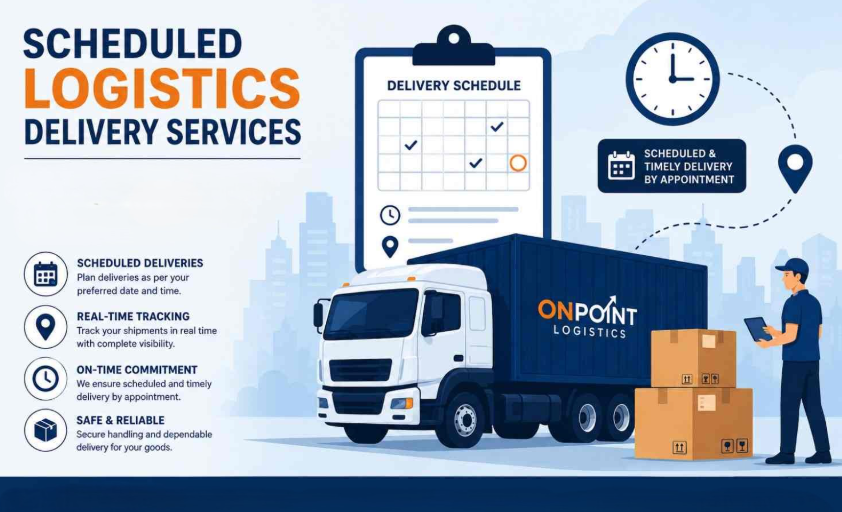
Scheduled and timely delivery by appointment becomes particularly useful when the receiving operation has limited capacity or strict access requirements.
Manufacturing facilities may allocate specific unloading windows. Retail distribution centres may require prior slot booking. Construction projects may need materials at a particular stage of work because storing large quantities on-site is difficult. Hospitals, commercial facilities, and other controlled locations can also have defined receiving procedures.
In these situations, timing is part of the service itself.
A delivery that arrives four hours early may still be inconvenient. A shipment that arrives two hours late can disrupt production or leave a vehicle waiting outside. The objective is not simply to make the vehicle move faster. It is to make the entire movement predictable enough for the receiving operation to plan around it.
What Technology Can and Cannot Fix
Modern logistics platforms can make scheduling considerably easier. Transportation management systems can track shipments, allocate vehicles, record delivery windows, and provide status updates. GPS data can help teams identify delays before the vehicle reaches the destination.
But technology does not automatically create good scheduling.
Bad input still produces bad planning.
If the receiving window is entered incorrectly, if transit assumptions are unrealistic, or if the consignee changes the appointment without updating the logistics team, even a sophisticated system can struggle.
The useful role of technology is to reduce manual coordination and improve visibility. A logistics manager should be able to see which shipments are scheduled, which are running late, which appointments are at risk, and where intervention is required.
For Onpoint Logistics, this kind of operational thinking is particularly relevant because scheduled movement is ultimately about connecting transportation planning with the customer’s actual receiving requirements, rather than treating delivery as the final and isolated step of transportation.
How Logistics Teams Should Decide Whether Scheduling Is Worth It
The best candidates for scheduled delivery are usually shipments where a missed time window creates a meaningful operational consequence. Before introducing a formal scheduling process, logistics teams should look at their actual delivery history rather than relying on assumptions.
Useful questions include:
- How often do vehicles wait at customer locations, and why?
- Which destinations regularly require appointment booking?
- How many deliveries are reattempted because the receiver was unavailable?
- Which customers have fixed unloading windows?
- What is the financial impact of vehicle detention and idle capacity?
- Are delivery commitments based on realistic transit times or optimistic estimates?
The answers usually reveal where scheduling will create the most value.
There is no need to impose complicated appointment systems on every shipment. Start with the routes, customers, and facilities where timing repeatedly causes operational friction.
The 2026 Shift: From Tracking Shipments to Managing Delivery Reliability
In 2026, logistics visibility is no longer limited to knowing where a vehicle is. Businesses increasingly expect logistics partners to provide useful information about what is likely to happen next.
That means identifying an appointment risk before the vehicle misses the slot, communicating delays early, and adjusting plans when receiving capacity changes.
Predictive tools and AI can support this process by analysing historical transit times, recurring delays, route conditions, and customer delivery patterns. But the value will come from how those insights are used by operations teams.
A prediction that says a vehicle may arrive late is useful only if someone can act on it.
The stronger model is therefore a combination of technology and operational judgment. Systems handle visibility and repetitive coordination, while experienced logistics teams deal with exceptions that cannot be predicted neatly.
That balance is likely to become more important as shipment volumes increase and customers become less tolerant of uncertain delivery windows.
Conclusion
Scheduled logistics delivery services are not really about putting more dates and times into a transport system. They are about making the delivery process fit the operating reality of the customer receiving the goods.
For logistics businesses, the biggest opportunity often lies in reducing the small inefficiencies that happen between pickup and final delivery: waiting vehicles, missed slots, unnecessary reattempts, poor communication, and unrealistic ETAs.
A well-designed scheduling process can address those problems without making logistics unnecessarily complicated. The key is to start with actual operational pain points, measure the cost of missed appointments, and build scheduling around realistic transportation capacity.
When delivery timing becomes predictable, the benefit reaches beyond the logistics department. Customers can plan inventory, warehouses can manage labour, vehicles can be utilized better, and businesses gain greater control over one of the most unpredictable parts of their supply chain.
FAQs
- What are scheduled logistics delivery services?
Scheduled logistics delivery services coordinate transportation around a predefined delivery date or receiving window. They are particularly useful when customers, warehouses, or facilities cannot accept shipments at arbitrary times.
- How do shipment scheduling services in India help businesses?
They help coordinate vehicle availability, pickup timing, transit planning, and customer receiving windows. This can reduce waiting time, missed appointments, delivery reattempts, and unnecessary vehicle utilization.
- Are scheduled deliveries more expensive than standard deliveries?
Not necessarily. A scheduled service may have a different transportation rate, but the total cost can be lower when it reduces detention, failed deliveries, storage issues, and operational disruption.
- When should a business use scheduled delivery?
It makes the most sense when the receiver has fixed unloading slots, limited warehouse capacity, controlled site access, or a strong dependency on delivery timing. Regular B2B and industrial shipments are common examples.
- What is the difference between scheduled delivery and an ETA?
An ETA is an estimated arrival time based on current conditions. A scheduled delivery involves an agreed delivery window or appointment that the logistics operation actively plans around.